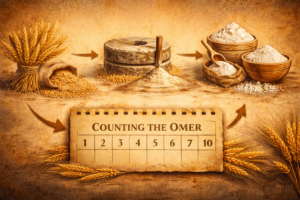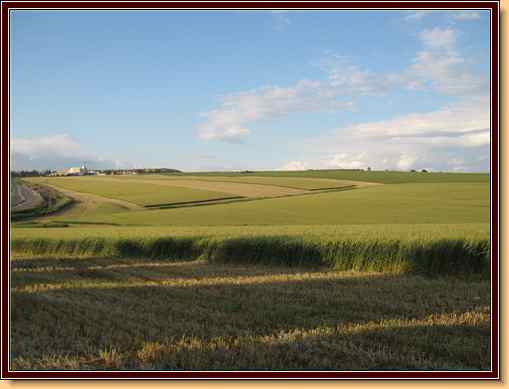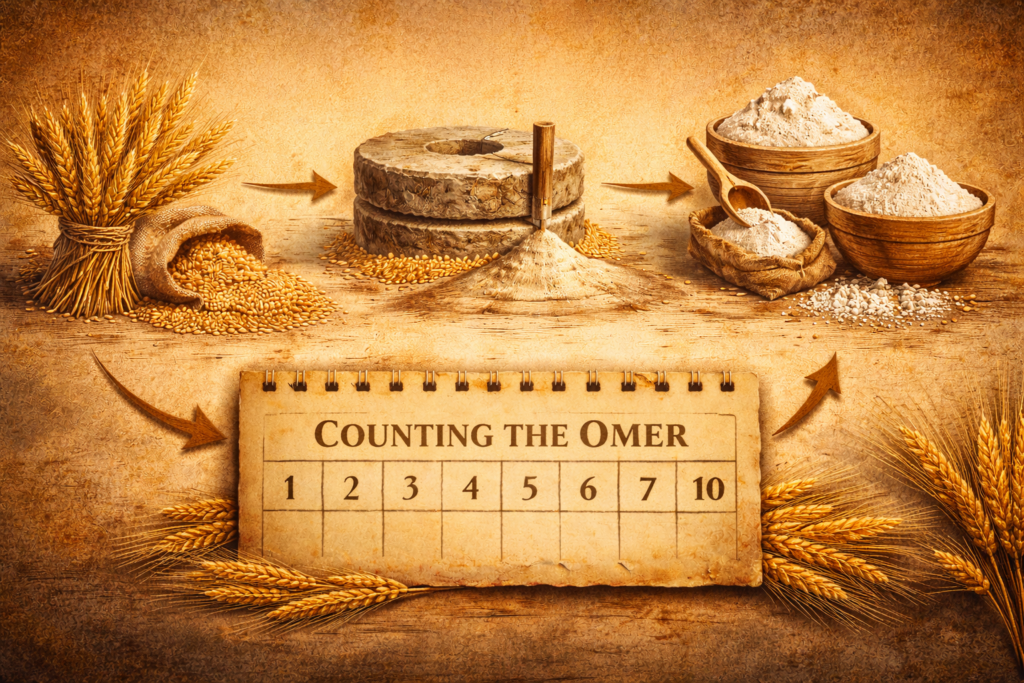
The Bible contains many appointed times and seasons, yet one of the longest and least understood is the period known as the Counting of the Omer. This season stretches across fifty days and holds deep spiritual meaning connected to provision, growth, remembrance, and obedience. When understood clearly, the Omer becomes more than tradition—it becomes a daily spiritual practice that teaches intentional living before the Lord.
What Does “Omer” Mean?
The word Omer comes from Hebrew and is found in Strong’s Concordance as H#6016, meaning a heap, a sheaf, or a dry measure. It is first introduced in connection with daily provision in the wilderness. In Exodus 16:16, each person gathered one omer of manna per day, a miracle that sustained Israel throughout their journey. This measure was so significant that an omer was eventually preserved as a testimony of God’s provision.
This connection reveals something important: the Omer is tied not only to harvest, but to daily dependence on God. It represents “enough for today,” reminding believers that provision comes from the Lord one day at a time.
The Command to Count
The command to count the Omer comes from Leviticus 23:15–16:
“And ye shall count unto you from the morrow after the sabbath, from the day that ye brought the sheaf of the wave offering; seven sabbaths shall be complete… Even unto the morrow after the seventh sabbath shall ye number fifty days…”
At first glance, the word “omer” does not appear in many English translations of this passage. However, deeper study reveals something important: the Hebrew word translated as sheaf in verse 15 is the same Hebrew word used for omer. That means the verse could correctly be understood as referring to “the Omer of the wave offering”. This establishes Leviticus 23:15 as the direct biblical command to count the Omer.
Counting and Numbering: Two Witnesses
The passage uses two related actions: counting in verse 15 and numbering in verse 16. In Hebrew, both words come from Strong’s H#5608, meaning to count, to record, to inscribe, to tally. This teaches that the process is not just mental counting but also involves recording and marking the days.
This idea reflects a biblical principle of two witnesses. Speaking the count aloud is one witness; writing or marking the count is the second. Together, they create remembrance and testimony before the Lord. The document explains that when a person speaks the count aloud, their voice continues as a testimony, and when they write it down, they establish proof of obedience.
When Does the Omer Begin?
One of the most important questions surrounding the Omer is timing. The text repeatedly emphasizes that the count must begin “the day after the Sabbath”. This is not a general reference to a festival rest day but specifically refers to the weekly Sabbath, identified by Strong’s H#7676.
The reasoning is clear:
The count must start the day after a Sabbath
The count must end the day after a Sabbath
Only the weekly Sabbath repeats every seven days
Seven Sabbaths must be “complete weeks”
No other feast-day Sabbaths fulfill this pattern
This leads to the conclusion that the Omer always begins on the first day of the week (Sunday) following the Sabbath during Passover week.
Why the Omer Matters Spiritually
The season of the Omer is not empty of biblical events. In fact, Scripture records several major events occurring during this exact timeframe:
Messiah was resurrected on the day after the Sabbath, the first day of the week (Mark 16:9), which aligns with Omer Day 1
He remained with His disciples for 40 days after resurrection (Acts 1:9)
Ten days later, on the 50th day, Shavuot (Pentecost) occurred
On that day, 3,000 were immersed, and the promise of Joel 2:28 was fulfilled
These events are directly tied to the Omer calendar, showing that this is not an empty season, but a time of profound biblical activity.
Practical Ways to Count the Omer
The document offers several creative and practical ideas for making the Omer a meaningful, hands-on experience—especially for families and children.
Some suggested practices include:
Marking off each day on a calendar
Using labeled envelopes or boxes (1–7) and placing one item inside each day
Creating an “Omer garden” by planting one seed per day for seven rows
Using paper clips, money chains, or physical markers to visualize the count
Setting phone alarms to remember to count at sunset
These methods emphasize that the Omer is not meant to be abstract—it is meant to be lived out daily. The goal is remembrance, intention, and participation.
The Omer as a Season of Growth
At its heart, the Omer teaches discipline. It teaches patience. It teaches daily obedience. Counting for fifty days forces believers to slow down and become aware of time, actions, and spiritual focus. It is a season designed for reflection, maturity, and preparation—just as Israel had to be shaped after leaving Egypt before standing at Sinai.
The repeated question becomes personal:
Will you count? Will you remember? Will you engage?
A Resource for Deeper Study
For those who would like to explore the meaning of the Omer more deeply and walk through this season with structure and clarity, Libby Davis offers a thoughtful resource called Omer and Bride Study Guide. Her book helps readers understand the biblical foundation of the Omer and how it connects to spiritual preparation and identity.
Libby also leads discussion-based classes where participants can learn together, ask questions, and grow in understanding in a supportive environment.
If you would like to take the next step:
👉 Consider ordering Omer and Bride Study Guide
👉 Consider joining Libby’s classes for deeper study and community learning
The Omer teaches us that transformation happens one day at a time—and with the right guidance, that journey can become rich, meaningful, and life-changing.